Monte Carlo Simulation
Lecture 10
March 4, 2024
MC Example: Finding \(\pi\)
Finding \(\pi\) by sampling random values from the unit square and computing the fraction in the unit circle. This is an example of Monte Carlo integration.
\[\frac{\text{Area of Circle}}{\text{Area of Square}} = \frac{\pi}{4}\]
Code
function circleShape(r)
    θ = LinRange(0, 2 * π, 500)
    r * sin.(θ), r * cos.(θ)
end

nsamp = 3000
unif = Uniform(-1, 1)
x = rand(unif, (nsamp, 2))
l = mapslices(v -> sum(v.^2), x, dims=2)
in_circ = l .< 1
pi_est = [4 * mean(in_circ[1:i]) for i in 1:nsamp]

plt1 = plot(
    1,
    xlim = (-1, 1),
    ylim = (-1, 1),
    legend = false,
    markersize = 4,
    framestyle = :origin,
    tickfontsize=16,
    grid=:false
    )
plt2 = plot(
    1,
    xlim = (1, nsamp),
    ylim = (3, 3.5),
    legend = :false,
    linewidth=3,
    color=:black,
    tickfontsize=16,
    guidefontsize=16,
    xlabel="Iteration",
    ylabel="Estimate",
    right_margin=5mm
)
hline!(plt2, [π], color=:red, linestyle=:dash)
plt = plot(plt1, plt2, layout=Plots.grid(2, 1, heights=[2/3, 1/3]), size=(600, 500))

plot!(plt, circleShape(1), linecolor=:blue, lw=1, aspectratio=1, subplot=1)


mc_anim = @animate for i = 1:nsamp
    if l[i] < 1
        scatter!(plt[1], Tuple(x[i, :]), color=:blue, markershape=:x, subplot=1)
    else
        scatter!(plt[1], Tuple(x[i, :]), color=:red, markershape=:x, subplot=1)
    end
    push!(plt, 2, i, pi_est[i])
end every 100

gif(mc_anim, "figures/mc_pi.gif", fps=3)
[ Info: Saved animation to /Users/vs498/Teaching/BEE4850/sp24/slides/figures/mc_pi.gif

MC Example: Dice
What is the probability of rolling 4 dice for a total of 19?
Can simulate dice rolls and find the frequency of 19s among the samples.
Code
function dice_roll_repeated(n_trials, n_dice)
    dice_dist = DiscreteUniform(1, 6)
    roll_results = zeros(n_trials)
    for i=1:n_trials
        roll_results[i] = sum(rand(dice_dist, n_dice))
    end
    return roll_results
end

nsamp = 10000
# roll four dice 10000 times
rolls = dice_roll_repeated(nsamp, 4)

# calculate probability of 19
sum(rolls .== 19) / length(rolls)

# initialize storage for frequencies by sample length
avg_freq = zeros(length(rolls))
std_freq = zeros(length(rolls))

# compute average frequencies of 19
avg_freq[1] = (rolls[1] == 19)
count = 1
for i=2:length(rolls)
    avg_freq[i] = (avg_freq[i-1] * (i-1) + (rolls[i] == 19)) / i
    std_freq[i] = 1/sqrt(i-1) * std(rolls[1:i] .== 19)
end

plt = plot(
    1,
    xlim = (1, nsamp),
    ylim = (0, 0.1),
    legend = :false,
    tickfontsize=16,
    guidefontsize=16,
    xlabel="Iteration",
    ylabel="Estimate",
    right_margin=8mm,
    color=:black,
    linewidth=3,
    size=(600, 400)
)
hline!(plt, [0.0432], color="red",
    linestyle=:dash)

mc_anim = @animate for i = 1:nsamp
    push!(plt, 1, i, avg_freq[i])
end every 100

gif(mc_anim, "figures/mc_dice.gif", fps=10)
[ Info: Saved animation to /Users/vs498/Teaching/BEE4850/sp24/slides/figures/mc_dice.gif

Uncertainty Propagation Flowchart
For example: What is the probability that a levee will be overtopped given climate and extreme sea-level uncertainty?

On Random Number Generators
Random number generators are not really random, only pseudorandom.
This is why setting a seed is important. But even that can go wrong…
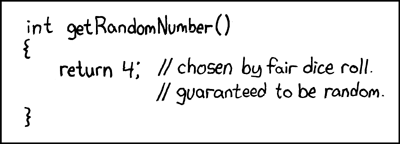
Source: XKCD #221