More Bayes and Extreme Value Modeling


Lecture 07

February 12, 2024

Last Class/More on Bayes

Bayesian Probability

From the Bayesian perspective, probability is interpreted as the degree of belief in an outcome or proposition.

There are two different types of random quantities: - Observable quantities, or data (also random for frequentists); - Unobservable quantities, or parameters/structures.

Conditional Probability Notation

Then it makes sense to discuss the probability of - model parameters \(\mathbf{\theta}\) - unobserved data \(\tilde{\mathbf{y}}\) - model structures \(\mathcal{M}\)

conditional on the observations \(\mathbf{y}\), which we can denote.

Bayesian Probability as Conditional Probability

This fundamental conditioning on observations \(p(\mathbf{\theta} | \mathbf{y})\) is a distinguishing feature of Bayesian inference.

Compare: frequentist approaches are based on re-estimating \(\theta^\mathbf{y}_{\text{MLE}}\) over the distribution of possible \(\mathbf{y}\) conditional on the “true” \(\hat{\theta}\).

Bayes’ Rule

\[\underbrace{{p(\theta | y)}}_{\text{posterior}} = \frac{\overbrace{p(y | \theta)}^{\text{likelihood}}}{\underbrace{p(y)}_\text{normalization}} \overbrace{p(\theta)}^\text{prior}\]

Sequential Bayesian Updating

Can update sequentially by treating the “old” posterior as the “new” prior:

\[p(\theta | y_{\text{old}}, y_{\text{new}}) \propto p(y_{new} | y_\text{old}, \theta) \color{red}p(y_{\text{old}} | \theta) p(\theta)\]

Credible Intervals

Bayesian credible intervals are straightforward to interpret: \(\theta\) is in \(I\) with probability \(\alpha\).

In other words, choose \(I\) such that \[p(\theta \in I | \mathbf{y}) = \alpha.\]

This is not usually a unique choice, but the “equal-tailed interval” between the \((1-\alpha)/2\) and \((1+\alpha)/2\) quantiles is a common choice.

Bayesian Model Components

A fully specified Bayesian model includes:

  1. Probability model for the data given the parameters (the likelihood), \(p(y | \theta)\)t
  2. Prior distributions over the parameters, \(p(\theta)\)

Prior Probabilities and Non-Identifiability

Can deal with non-identifiability issues for complex models, such as hierarchical models by placing appropriate priors to distinguish between components or specify dependence between levels.

Hierarchical Models

\[\begin{align} y_j | \theta_j, \phi &\sim P(y_j | \theta_j, \phi) \nonumber \\ \theta_j | \phi &\sim P(\theta_j | \phi) \nonumber \\ \phi &\sim P(\phi) \nonumber \end{align}\]

Mixture Models

\[\begin{align} y_j | \theta_{z_j} &\sim P(y_j | \theta_{z_j}) \\ z_j &\sim \text{Categorical}(\phi) \\ \theta_{z_j} &\sim P(\theta_{z_j}) \\ \phi &\sim P(\phi) \end{align}\]

Generative Modeling

Bayesian models lend themselves towards generative simulation by generating new data \(\tilde{y}\) through the posterior predictive distribution:

\[p(\tilde{y} | \mathbf{y}) = \int_{\Theta} p(\tilde{y} | \theta) p(\theta | \mathbf{y}) d\theta\]

This allows us to test the model through simulation (e.g. hindcasting) and generate probabilistic predictions.

What Makes A Good Prior?

  • Reflects level of understanding (informative vs. weakly informative vs. non-informative).
  • Does not zero out probability of plausible values.
  • Regularization (extreme values should be less probable)

What Makes A Bad Prior?

  • Assigns probability zero to plausible values;
  • Weights implausible values equally as more plausible ones;
  • Double counts information (e.g. fitting a prior to data which is also used in the likelihood)
  • Chosen based on vibes.

Modeling Extreme Values

Extreme Values and Environmental Data

Source: Doss-Gollin & Keller (2023)

Extreme Values and Environmental Data

  • Streamflow
  • Precipitation
  • Storm tides
  • Heat waves
  • Wind speeds

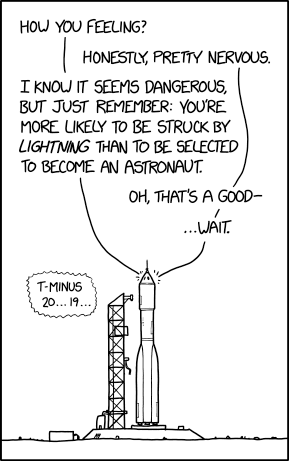
Extreme Values and Risk

Source: XKCD 2107

Return Periods and Return Levels

  • Exceedance probability (often framed as annual exceedance probability (AEP)) \(p\)
  • Return period or recurrence interval: $T=
  • Return level: Value that will be exceeded with probability \(p=\frac{1}{T}\), aka the \(1-p\) quantile.

Why Is Modeling/Extrapolating Extremes Challenging?

  • Not much data
  • Sensitive to small changes in distributional assumptions/tail areas (Exercise 4!)

Impact of Distribution Change on Extremes

Code
xhi = quantile(Normal(0, 2), 0.975)
xlo = quantile(Normal(0, 2), 0.025)

p1 = plot(Normal(0, 2), label="Base", linewidth=2, color=:black, xticks=:false, yticks=:false, guidefontsize=16, legendfontsize=14, tickfontsize=14)
plot!(Normal(0.5, 2), label="Shifted Mean", linewidth=2, color=:black, linestyle=:dash)
plot!(xhi:0.01:8, Normal(0, 2), color=:red, linewidth=0, fill=(0, 0.5, :red), label=false)
plot!(xhi:0.01:8, Normal(0.5, 2), color=:red, linewidth=0, fill=(0, 0.5, :red), label=false)
xlabel!("Variable")
plot!(size=(500, 400))

nsamples = 100000
xhi = quantile(Normal(0, 2), 0.99)
xbase = rand(Normal(0, 2), nsamples)
xshift = rand(Normal(0.5, 2), nsamples)
p2 = plot(sort(xbase), 1(nsamples:-1:1) ./ nsamples, label="Base", color=:black, linewidth=2, xticks=:false, guidefontsize=16, legendfontsize=14, tickfontsize=14)
xlabel!("Variable")
xlims!((-7, 6))
ylims!((1/1000, 1))
plot!(sort(xshift), 1(nsamples:-1:1) ./ nsamples, color=:black, linestyle=:dash, linewidth=2, label="Shifted Mean", legend=:bottomleft)
yticks = [1, 1/10, 1/50, 1/100, 1/1000]
yaxis!("Exceedance Probability", yticks, :log, formatter=y -> string(round(y; digits=3)))
hline!([1-cdf(Normal(0, 2), xhi)], color=:red, label=:false)
hline!([1-cdf(Normal(0.5, 2), xhi)], color=:red, label=:false, linestyle=:dash, linewidth=2)
vline!([xhi], color=:blue, linewidth=2, label=:false)
yticks = [1, 1/10, 1/50, 1/100, 1/1000]
yaxis!("Exceedance Probability", yticks, :log, formatter=y -> string(round(y; digits=3)))
plot!(size=(500, 400))

display(p1)
display(p2)
(a) Impact of distributional assumptions on extreme frequencies.
(b)
Figure 1

Frequency of Cccurrence ≠ Extreme impacts

Extremity of Winter Storm Uri Heat Demands

Source: Doss-Gollin et al. (2021)

Theoretical Frameworks for Extremes

Two Ways to Frame “Extremes”

  1. What is the distribution of “block” extremes, e.g. annual maxima (block maxima)?
  2. What is the distribution of extremes which exceed a certain value (peaks over threshold)?

Example: Tide Gauge Data

Code
function load_data(fname)
    date_format = "yyyy-mm-dd HH:MM"
    # this uses the DataFramesMeta package -- it's pretty cool
    return @chain fname begin
        CSV.File(; dateformat=date_format)
        DataFrame
        rename(
            "Time (GMT)" => "time", "Predicted (m)" => "harmonic", "Verified (m)" => "gauge"
        )
        @transform :datetime = (Date.(:Date, "yyyy/mm/dd") + Time.(:time))
        select(:datetime, :gauge, :harmonic)
        @transform :weather = :gauge - :harmonic
        @transform :month = (month.(:datetime))
    end
end

dat = load_data("data/surge/norfolk-hourly-surge-2015.csv")

p1 = plot(dat.datetime, dat.gauge; ylabel="Gauge Measurement (m)", label="Observed", legend=:topleft, tickfontsize=14, guidefontsize=16, legendfontsize=14, xlabel="Date/Time", bottom_margin=5mm, left_margin=5mm, right_margin=5mm)
Figure 2: 2015 tide gauge data from the Norfolk, VA tide gauge.

Example: Tide Gauge Data

Code
plot!(p1, dat.datetime, dat.harmonic, label="Predicted", alpha=0.7)
Figure 3: 2015 tide gauge data with predicted harmonics from the Norfolk, VA tide gauge.

Example: Detrended Data

Code
plot(dat.datetime, dat.weather; ylabel="Gauge Weather Variability (m)", label="Detrended Data", linewidth=3, legend=:topleft, tickfontsize=14, guidefontsize=16, legendfontsize=14, xlabel="Date/Time", bottom_margin=5mm, left_margin=5mm, right_margin=5mm)
Figure 4: 2015 detrended tide gauge data from the Norfolk, VA tide gauge.

Example: Block Maxima

Code
p1 = plot(dat.datetime, dat.weather; ylabel="Gauge Weather Variability (m)", label="Detrended Data", linewidth=2, legend=:topleft, tickfontsize=14, guidefontsize=16, legendfontsize=14, xlabel="Date/Time", bottom_margin=5mm, left_margin=5mm, right_margin=5mm)
max_dat = combine(dat -> dat[argmax(dat.weather), :], groupby(transform(dat, :datetime => x->yearmonth.(x)), :datetime_function))
scatter!(max_dat.datetime, max_dat.weather, label="Monthly Maxima", markersize=5)
month_start = collect(Date(2015, 01, 01):Dates.Month(1):Date(2015, 12, 01))
vline!(DateTime.(month_start), color=:black, label=:false, linestyle=:dash)

p2 = histogram(
    max_dat.weather,
    normalize=:pdf,
    orientation=:horizontal,
    label=:false,
    xlabel="PDF",
    ylabel="",
    yticks=[],
    tickfontsize=16,
    guidefontsize=18
)

l = @layout [a{0.7w} b{0.3w}]
plot(p1, p2; layout=l, link=:y, ylims=(-0.4, 1.4), bottom_margin=5mm, left_margin=5mm)
plot!(size=(1000, 450))
Figure 5: 2015 detrended tide gauge data from the Norfolk, VA tide gauge.

Example: Peaks Over Threshold

Code
thresh = 0.5
p1 = plot(dat.datetime, dat.weather; linewidth=2, ylabel="Gauge Weather Variability (m)", label="Observations", legend=:top, tickfontsize=14, guidefontsize=16, legendfontsize=14, xlabel="Date/Time")
hline!([thresh], color=:red, linestyle=:dash, label="Threshold")
scatter!(dat.datetime[dat.weather .> thresh], dat.weather[dat.weather .> thresh], markershape=:x, color=:black, markersize=3, label="Exceedances")

p2 = histogram(
    dat.weather[dat.weather .> thresh],
    normalize=:pdf,
    orientation=:horizontal,
    label=:false,
    xlabel="PDF",
    ylabel="",
    yticks=[],
    tickfontsize=16,
    guidefontsize=18
)

l = @layout [a{0.7w} b{0.3w}]
plot(p1, p2; layout=l, link=:y, ylims=(-0.4, 1.4), bottom_margin=5mm, left_margin=5mm)
plot!(size=(1000, 450))
Figure 6: 2015 detrended tide gauge data from the Norfolk, VA tide gauge.

Modeling Extremes

San Francisco Tide Gauge Data

Code
# load SF tide gauge data
# read in data and get annual maxima
function load_data(fname)
    date_format = DateFormat("yyyy-mm-dd HH:MM:SS")
    # This uses the DataFramesMeta.jl package, which makes it easy to string together commands to load and process data
    df = @chain fname begin
        CSV.read(DataFrame; header=false)
        rename("Column1" => "year", "Column2" => "month", "Column3" => "day", "Column4" => "hour", "Column5" => "gauge")
        # need to reformat the decimal date in the data file
        @transform :datetime = DateTime.(:year, :month, :day, :hour)
        # replace -99999 with missing
        @transform :gauge = ifelse.(abs.(:gauge) .>= 9999, missing, :gauge)
        select(:datetime, :gauge)
    end
    return df
end

dat = load_data("data/surge/h551.csv")

# detrend the data to remove the effects of sea-level rise and seasonal dynamics
ma_length = 366
ma_offset = Int(floor(ma_length/2))
moving_average(series,n) = [mean(@view series[i-n:i+n]) for i in n+1:length(series)-n]
dat_ma = DataFrame(datetime=dat.datetime[ma_offset+1:end-ma_offset], residual=dat.gauge[ma_offset+1:end-ma_offset] .- moving_average(dat.gauge, ma_offset))

# group data by year and compute the annual maxima
dat_ma = dropmissing(dat_ma) # drop missing data
dat_annmax = combine(dat_ma -> dat_ma[argmax(dat_ma.residual), :], groupby(transform(dat_ma, :datetime => x->year.(x)), :datetime_function))
delete!(dat_annmax, nrow(dat_annmax)) # delete 2023; haven't seen much of that year yet
rename!(dat_annmax, :datetime_function => :Year)
select!(dat_annmax, [:Year, :residual])
dat_annmax.residual = dat_annmax.residual / 1000 # convert to m

# make plots
p1 = plot(
    dat_annmax.Year,
    dat_annmax.residual;
    xlabel="Year",
    ylabel="Annual Max Tide Level (m)",
    label=false,
    marker=:circle,
    markersize=5,
    tickfontsize=16,
    guidefontsize=18
)
p2 = histogram(
    dat_annmax.residual,
    normalize=:pdf,
    orientation=:horizontal,
    label=:false,
    xlabel="PDF",
    ylabel="",
    yticks=[],
    tickfontsize=16,
    guidefontsize=18
)

l = @layout [a{0.7w} b{0.3w}]
plot(p1, p2; layout=l, link=:y, ylims=(1, 1.7), bottom_margin=5mm, left_margin=5mm)
plot!(size=(1000, 450))
Figure 7: Annual maxima surge data from the San Francisco, CA tide gauge.

Proposed Probability Model

\[ \begin{align*} & y \sim LogNormal(\mu, \sigma) \tag{likelihood}\\ & \left. \begin{aligned} & \mu \sim Normal(0, 1) \\ & \sigma \sim HalfNormal(0, 5) \end{aligned} \right\} \tag{priors} \end{align*} \]

Want to find:

\[p(\mu, \sigma | y) \propto p(y | \mu, \sigma) p(\mu)p(\sigma)\]

Are Our Priors Reasonable?

Hard to tell! Let’s simulate data to see we get plausible outcomes.

This is called a prior predictive check.

Prior Predictive Check

Code
# sample from priors
μ_sample = rand(Normal(0, 1), 1_000)
σ_sample = rand(truncated(Normal(0, 5), 0, +Inf), 1_000)

# define return periods and cmopute return levels for parameters
return_periods = 2:100
return_levels = zeros(1_000, length(return_periods))
for i in 1:1_000
    return_levels[i, :] = quantile.(LogNormal(μ_sample[i], σ_sample[i]), 1 .- (1 ./ return_periods))
end

plt_prior_1 = plot(; yscale=:log10, yticks=10 .^ collect(0:2:16), ylabel="Return Level (m)", xlabel="Return Period (yrs)",
    tickfontsize=16, legendfontsize=18, guidefontsize=18, bottom_margin=10mm, left_margin=10mm, legend=:topleft)
for idx in 1:1_000
    label = idx == 1 ? "Prior" : false
    plot!(plt_prior_1, return_periods, return_levels[idx, :]; color=:black, alpha=0.1, label=label)
end
plt_prior_1
Figure 8: Prior predictive check of return periods with revised model

Let’s Revise the Prior

\[ \begin{align*} & y \sim LogNormal(\mu, \sigma) \tag{likelihood}\\ & \left. \begin{aligned} & \mu \sim Normal(0, 0.5) \\ & \sigma \sim HalfNormal(0, 0.1) \end{aligned} \right\} \tag{priors} \end{align*} \]

Prior Predictive Check 2

Code
# sample from priors
μ_sample = rand(Normal(0, 0.5), 1_000)
σ_sample = rand(truncated(Normal(0, 0.1), 0, +Inf), 1_000)

return_periods = 2:100
return_levels = zeros(1_000, length(return_periods))
for i in 1:1_000
    return_levels[i, :] = quantile.(LogNormal(μ_sample[i], σ_sample[i]), 1 .- (1 ./ return_periods))
end

plt_prior_2 = plot(; ylabel="Return Level (m)", xlabel="Return Period (yrs)", tickfontsize=16, legendfontsize=18, guidefontsize=18, bottom_margin=10mm, left_margin=10mm)
for idx in 1:1_000
    label = idx == 1 ? "Prior" : false
    plot!(plt_prior_2, return_periods, return_levels[idx, :]; color=:black, alpha=0.1, label=label)
end
plt_prior_2
Figure 9: Prior predictive check of return periods with revised model

Compute Posterior

Code
ll(μ, σ) = sum(logpdf(LogNormal(μ, σ), dat_annmax.residual))
lprior(μ, σ) = logpdf(Normal(0, 0.5), μ) + logpdf(truncated(Normal(0, 0.1), 0, Inf), σ)
lposterior(μ, σ) = ll(μ, σ) + lprior(μ, σ)

p_map = optimize(p -> -lposterior(p[1], p[2]), [0.0, 0.0], [1.0, 1.0], [0.5, 0.5]).minimizer

μ = 0.15:0.005:0.35
σ = 0.04:0.01:0.1
posterior_vals = @. lposterior', σ)

contour(μ, σ, posterior_vals, 
    levels=100, 
    clabels=false, 
    cbar=true, lw=1, 
    fill=(true,cgrad(:grays,[0,0.1,1.0])),
    tickfontsize=16,
    guidefontsize=18,
    legendfontsize=18,
    right_margin=20mm,
    bottom_margin=5mm,
    left_margin=5mm
)
scatter!([p_map[1]], [p_map[2]], label="MAP", markersize=10, marker=:star)
xlabel!(L"$\mu$")
ylabel!(L"$\sigma$")
plot!(size=(900, 400))
Figure 10: Posterior samples from surge model.
2-element Vector{Float64}:
 0.2546874075930782
 0.055422136861588964

Assess MAP Fit

Code
p1 = histogram(
    dat_annmax.residual,
    normalize=:pdf,
    legend=:false,
    ylabel="PDF",
    xlabel="Annual Max Tide Level (m)",
    tickfontsize=16,
    guidefontsize=18,
    bottom_margin=5mm, left_margin=5mm
)
plot!(p1, LogNormal(p_map[1], p_map[2]),
    linewidth=3,
    color=:red)
xlims!(p1, (1, 1.7))
plot!(p1, size=(600, 450))

return_periods = 2:500
return_levels = quantile.(LogNormal(p_map[1], p_map[2]), 1 .- (1 ./ return_periods))

# function to calculate exceedance probability and plot positions based on data quantile
function exceedance_plot_pos(y)
    N = length(y)
    ys = sort(y; rev=false) # sorted values of y
    nxp = xp = [r / (N + 1) for r in 1:N] # exceedance probability
    xp = 1 .- nxp
    return xp, ys
end
xp, ys = exceedance_plot_pos(dat_annmax.residual)

p2 = plot(return_periods, return_levels, linewidth=3, color=:blue, label="Model Fit", tickfontsize=16, legendfontsize=18, guidefontsize=18, bottom_margin=5mm, left_margin=5mm, right_margin=10mm, legend=:bottomright)
scatter!(p2, 1 ./ xp, ys, label="Observations", color=:black, markersize=5)
xlabel!(p2, "Return Period (yrs)")
ylabel!(p2, "Return Level (m)")
xlims!(-1, 300)
plot!(p2, size=(600, 450))

display(p1)
display(p2)
(a) Checks for model fit.
(b)
Figure 11

Key Points and Upcoming Schedule

Key Points: Bayesian Statistics

  • Probability as degree of belief
  • Bayes’ Rule as the fundamental theorem of conditional probability
  • Bayesian updating as an information filter
  • Prior selection important: lots to consider!
  • Credible Intervals: Bayesian representations of uncertainty

Key Points: Extremes

  • Easy to under-estimate extreme events due to lack of data;
  • Two different approaches to understanding extremes
    • Block Maxima
    • Peaks over Thresholds
  • These require different statistical approaches (more next week…)

Next Classes

Wednesday: No class

Monday: Extreme Value Theory and Models

Assessments

Exercise 4: Assigned, due Friday

Reading: Doss-Gollin et al. (2021)

References

References

Doss-Gollin, J., & Keller, K. (2023). A subjective Bayesian framework for synthesizing deep uncertainties in climate risk management. Earths Future, 11, e2022EF003044. https://doi.org/10.1029/2022ef003044
Doss-Gollin, J., Farnham, D. J., Lall, U., & Modi, V. (2021). How unprecedented was the February 2021 Texas cold snap? Environ. Res. Lett., 16, 064056. https://doi.org/10/gnswvt